

When Jesus answered a question from some Pharisees about divorce (in Matthew 19:3‑10 and Mark 10:2‑12), he uttered the famous phrase, “What God has joined together, let not man separate.” And in his reply he alluded to Adam and Eve by quoting phrases from Genesis 1 and 2 that included the terms “male and female”, “man”, “wife”, “two” and “one flesh” [1]. In general, in Christian theology, all these elements have been taken as defining marriage. But Christians in favour of “gay marriage”, in other words, unions between two people of the same sex, question the need for this interpretation. 🤔
Today I’ll explain some of their arguments. 😃
A key text
First of all, I ought to emphasise that what Jesus says to the Pharisees on this occasion is a key text in the homosexuality debate.
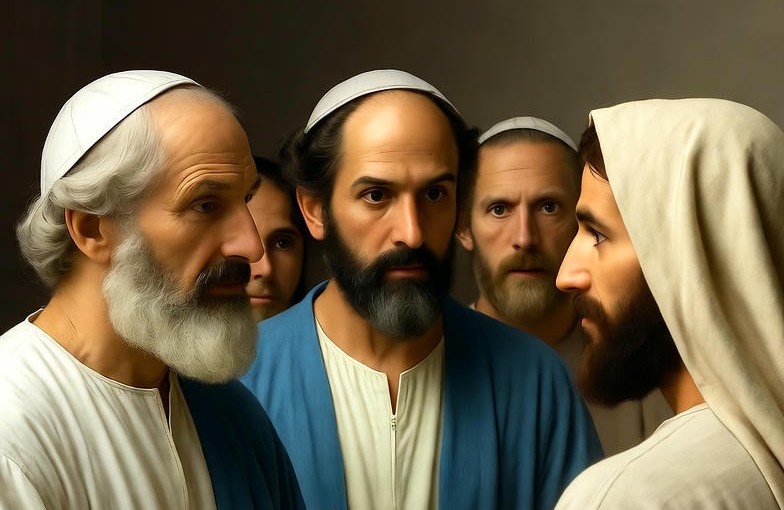
Jesus with some Pharisees or rabbis, by Grok.
☝️It’s not an exaggeration to say that it provides probably the most important biblical argument for rejecting gay marriage. Much more so than the tiny handful of verses that appear to condemn homosexuality (which have their problems, see this previous post).
There’s no doubt that a majority of Christians see in these words of Jesus unequivocal support for traditional heterosexual marriage.
☝️At the same time, there are other Christians, equally committed to the teachings of Jesus, who see good reasons for not necessarily taking his comments to the Pharisees as an exact or exclusive definition of marriage. These are not just believers in the LGTBI+🌈 community. They also include respected theologians, pastors and leaders in our churches ⛪, who, though heterosexual themselves, have come to this conclusion. How can that be?

Photo by krakenimages on Unsplash.
The context is crucial
To try to find a strict universal application for something Jesus said in a given context, to specific people, can be foolhardy. For instance, do we take it as an absolute principle never to invite friends or relatives for a meal 🥗🥩🍷 in our home, based on these words of Jesus?:
When you give a luncheon or dinner, do not invite your friends, your brothers or sisters, your relatives, or your rich neighbours; if you do, they may invite you back and so you will be repaid. But when you give a banquet, invite the poor, the crippled, the lame, the blind, and you will be blessed. Although they cannot repay you, you will be repaid at the resurrection of the righteous.
(Luke 14:12b‑14, NIVUK [2])
I would guess that few, if any, of us see this as an absolute. We note that Jesus was speaking “to his host” (Luke 14:12a), an influential and well-to-do Pharisee. And that the context is the guests’ snobbishness and desire for prominence.

Image created by Grok.
🫵 Having said that, maybe we should still take more seriously the attitude and priorities that Jesus was pointing to.
The specific context in this case
What we’re focussing on today is described by Matthew and Mark as a query about the legitimate reasons for a man to divorce his wife. This stemmed from a theological discussion at the time between two rabbinical schools (Hillel and Shammai) about the possibility of divorce “for just any reason”🫰, however insignificant [3].

Some rabbis arguing, by Grok.
According to Hillel (whose view was already the majority position in Jesus’s time) even a burnt or badly cooked 🥣 meal could be enough for a divorce, based on what the Law of Moses says in Deuteronomy 24:1.
Jesus refused to enter into their legalistic interpretive discussion. He appealed directly to a higher authority than Moses: 👉 God himself and his divine purpose regarding marriage when he created the world.
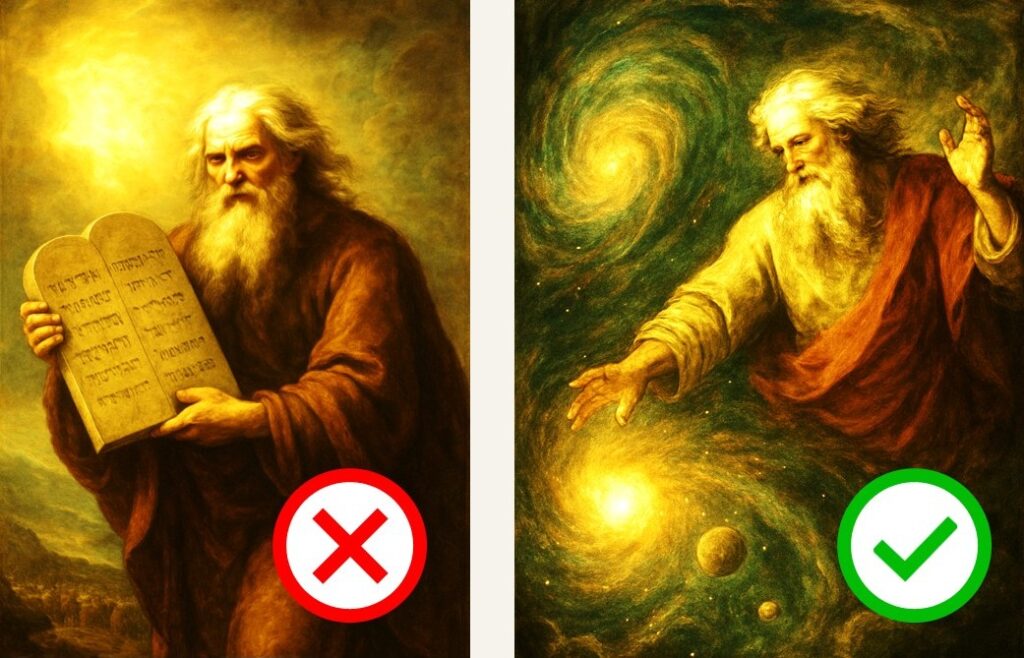
Moises vs. God, using images by ChatGPT.
Jesus’s comment about “man” not separating the marital bond can obviously be understood, in a broad general sense, as referring to everybody 🌎. But his immediate target 🎯 was undoubtedly the rabbis and Pharisees whose interpretation encouraged “easy divorce”, for any trivial matter.
And it’s also worth noting that Jesus had no truck with using one specific verse in Deuteronomy as justification. He showed it was important to seek God’s will in a more general way 🔍, taking into account his character and his dealings with humankind.
And what about “male and female”?
It was the Pharisees themselves who spoke about 👩🏻🤝👨🏽 man and woman/wife (the Greek word has both meanings) in their question. Jesus simply replied in a similar vein. So there’s no need to assume, in the words of Jesus, a special interest in defining marriage.
What’s more, no one there was considering anything other than heterosexual marriage. “Gay marriage” was unthinkable in that time and place 🙃.

Photo by Joeyy Lee on Unsplash.
And the whole emphasis of Jesus’s answer centred on the goal of permanence in the marriage relationship, as God’s divine aim. And that no one should make it easy to weaken or break the marriage bond.
Not taking Jesus’s words as absolutes
We’ve already mentioned this, regarding Jesus’s instructions about not inviting friends or relatives home for a meal.
But it’s worth emphasizing that in relation to marriage and divorce the Bible itself gives us several reasons for not taking Jesus’s words in an absolute sense, applicable to all situations:
- Matthew included in Jesus’s words an exception, a legitimate ground for divorce: the Greek term porneia (Matthew 5:32 and Matthew 19:9), which has to do with sexual immorality. Its meaning here is debated 💬, and it’s translated in different ways in our Bibles [4], but it was obviously an exception to the rule.
- The apostle Paul also offered us an exception (in 1 Corinthians 7:15). He saw that there were cases of converts whose unbelieving spouses did not want to continue in the relationship 🫷, where divorce was best. In all likelihood, according to most modern Bible scholars, that included the possibility of remarrying.
- These days, many commentators also note that the “hardness of heart” that Jesus pointed to still exists. Sometimes, then, divorce is unavoidable ⛓️💥 and, of all the options, may be the least bad alternative 😐.

Photo by Vitaly Gariev on Unsplash.
So, if we don’t take Jesus’s words about divorce as absolutes, maybe we don’t need to do so with “male and female” either. 🤔 At the very least, we know that Jesus could be very compassionate and understanding faced with irregular or frowned upon situations in that society, such as the Samaritan woman who had had five husbands and was now living with a man she was not married to (John 4:5‑42).
If none of this convinces you
I fully understand those Christians who are reluctant to rethink what has always seemed so clear to them in the Bible about sexuality, marriage, gender, and so on. For a long time I was one of them 🙂. But very gradually, and not without a fair bit of teetering back and forth 🥴, I came to a point where:
- Firstly, I gained an enormous respect for Christian thinkers that had adopted an affirming stance on homosexuality. 🤔 Not only did they have some really good arguments, but on many other issues they seemed to be spot on, and thoroughly in tune with the gospel message. 👏
- Secondly, I re-examined the way I myself read and understood the Bible as the word of God 📖. I still strive for it to inspire and challenge me. But I refuse to get tied up in knots through a literalist approach which, in reality, cannot be truly maintained in any coherent way.
Throughout this process I have had to remember, over and again, that God wants us to be merciful, not judgmental [5]. And that the Pharisees, so upright and scrupulous with the Scriptures, and always ready to point the finger at others 🫵, were the ones most criticised by Jesus.

📌 If you would like to comment on this post (in the language of your choice), you can do so at the end of the Spanish version, here.
Notes
[1] These are the words that occur in practically all English translations. The first expression, “male and female”, comes from Genesis 1:27 (part of the first creation account). And the words “man”, “his wife” and “one flesh” are taken from Genesis 2:24 (the end of the second creation account). The word “two” does not figure in the Hebrew (Masoretic) text of Genesis 2, only in the Greek translation, the Septuagint (LXX), in Genesis 2:24 and 2:25.
[2] NIVUK: The Holy Bible, New International Version® (Anglicised), NIV®, copyright © 1979, 1984, 2011 by Biblica, Inc.®, used by permission of Biblica, Inc.®; all rights reserved worldwide.
[3] Only Matthew (Matthew 19:3) clearly identifies the crux of the Pharisees’ question. The rabbinical discussion centred on the meaning of the Hebrew expression ervat davar, used in Deuteronomy 24:1, as a legitimate reason for a man to divorce his wife. This Hebrew expression is strange, vague, and difficult to translate. This is evidenced in modern translations, that range from “something about her he doesn’t like”, “something objectionable”, “some unseemly thing”, or “something wrong with her”, to “something indecent”. BibleGateway gives us a pretty complete list with this link.
[4] The Greek term porneia could refer to a wide range of illicit or immoral sexual behaviours. That’s why many modern translations translate it in these verses in Matthew with very general terms, such as “sexual immorality” (NIV, ESV, …) or “unchastity” (RSV, …).
Many commentators, at least in the Protestant tradition, assume that it probably refers to “unfaithfulness” (GNT, Phillips, …), or maybe the non-virginity of the bride, hence “fornication” (KJV, …). However, most translations (MSG is a notable exception) avoid directly translating porneia as “adultery”, in order to ensure a contrast with the Greek verb moichao occurring in the same verse, which does simply mean “to commit adultery”. For their part, some, but not all, Catholic Bibles (NABRE, …), for doctrinal reasons, favour translations positing unlawful (hence, annullable) marriages. There is a pretty complete list of all the ways porneia has been translated in these BibleGateway links: Matthew 5:32, Matthew 19:9.
[5] This is a recurring theme in the New Testament. See, for example: Matthew 5:7, 9:13, 12:7, 23:23; Luke 6:37; James 2:13, 3:17.